

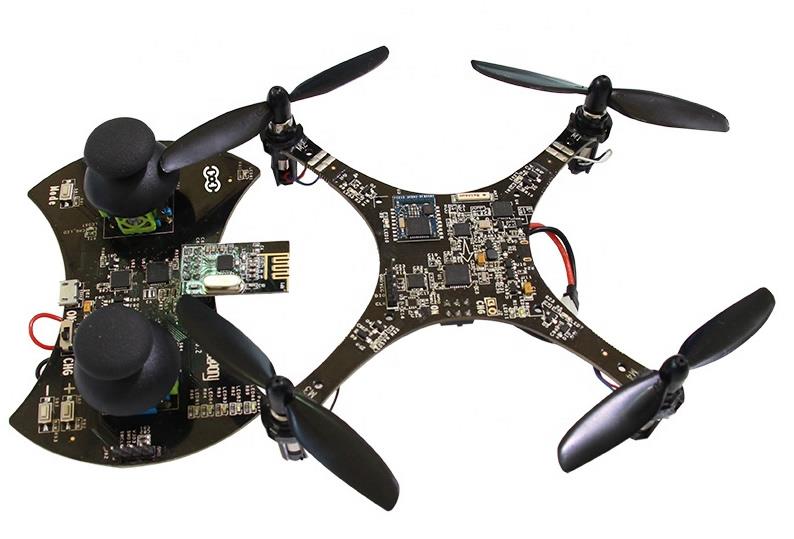
Quadrotor RC Drone aircraft Control PCB Assembly Solution
 11 Dec 2025 09:10:31 GMT
Tyson From www.hycxpcba.com
11 Dec 2025 09:10:31 GMT
Tyson From www.hycxpcba.com
The world of unmanned aerial vehicles (UAVs), commonly known as drones, is rapidly evolving.
At the heart of every high-performing quadrotor drone lies a sophisticated printed circuit board (PCB) that controls its flight, navigation,
and overall functionality. As drone technology advances, the demand for specialized PCB solutions tailored to the unique requirements of quadrotor drones is soaring.
This article delves into the crucial role of PCBs in quadrotor drone control, exploring the design considerations, manufacturing processes,
and innovative solutions offered
by Hycxpcba to empower drone developers and manufacturers.
Introduction: The Brains Behind the Flight
Quadrotor drones have revolutionized numerous industries, from logistics and agriculture to surveillance and entertainment,
largely due to their agility and versatility.
At the very heart of a quadrotor drone's sophisticated capabilities lies its control Printed Circuit Board (PCB),
functioning as the central nervous system that orchestrates every intricate movement and decision.
This vital component translates pilot commands and environmental data into precise motor actions, ensuring stable flight, accurate navigation, and seamless communication.
Without a meticulously designed and manufactured control PCB, the advanced functionalities and reliable performance expected of modern quadrotors would simply not be possible.
-
What is a Quadrotor Drone?
A quadrotor drone is an unmanned aerial vehicle (UAV) that utilizes four rotors for lift and propulsion, enabling vertical takeoff and landing, hovering, and multi-directional flight. - Each rotor's speed and direction can be individually controlled to achieve complex maneuvers, making them highly agile and adaptable for various applications.
-
Why is the Control PCB so Critical?
The control PCB is the central processing unit and communication hub of a quadrotor drone. - It integrates various sensors (gyroscopes, accelerometers, barometers, GPS), processes their data in real-time,
- executes flight control algorithms, manages power distribution to motors, and facilitates wireless communication with the remote controller. Essentially,
- it's the "brain" that interprets commands and environmental feedback to maintain stable flight and execute desired actions.
- Its reliability directly impacts the drone's safety, performance, and operational efficiency.
-
How does the PCB enable Flight Control?
The PCB houses the microcontroller or flight controller unit (FCU) which runs the drone's firmware. - This firmware continuously receives data from onboard sensors, such as orientation from IMUs (Inertial Measurement Units) and position from GPS.
- Based on this input and pilot commands, the FCU calculates the required thrust for each of the four motors.
- These calculations are then translated into PWM (Pulse Width Modulation) signals sent to the Electronic Speed Controllers (ESCs),
- which in turn regulate the motor speeds, allowing the drone to lift, hover, move, or rotate precisely.

Key Functions of a Quadrotor Drone Control PCB
The Quadrotor Drone Control PCB serves as the central nervous system, integrating diverse functionalities crucial for stable and agile flight.
Beyond mere connectivity, it orchestrates the intricate dance between sensing, processing, and actuation, directly impacting flight performance,
stability, and responsiveness. A robust and intelligently designed PCB is paramount for converting user commands and environmental data into precise motor actions, thereby enabling complex maneuvers and autonomous operations. From managing power distribution to executing complex algorithms, the PCB's capabilities define the drone's operational envelope and reliability.

-
Motor Control and ESC Integration
The PCB precisely controls the drone's motors via Electronic Speed Controllers (ESCs). It sends pulse-width modulation (PWM) signals to each ESC, - regulating motor speed and direction. This synchronized control across all four rotors is fundamental for achieving lift, thrust, and directional stability,
- allowing for precise ascend, descend, and translational movements. Advanced PCBs often feature integrated ESCs or dedicated interfaces for seamless integration, optimizing power efficiency and minimizing electromagnetic interference (EMI).
-
Sensor Data Processing
Modern quadrotors rely on a suite of sensors to gather real-time environmental and positional data. - The PCB acts as the hub for processing inputs from accelerometers, gyroscopes, magnetometers, barometers, and GPS modules.
- It filters noise, calibrates raw data, and converts analog signals into digital formats for the flight controller unit.
- This data is critical for determining the drone's attitude (pitch, roll, yaw), altitude, heading, and global position, forming the basis for stable flight and navigation algorithms.
- High-speed data buses and robust filtering circuits are essential to ensure data integrity and real-time responsiveness.
-
Navigation and Flight Control Algorithms
At the core of the PCB's intelligence lies the flight controller, which executes sophisticated algorithms for navigation, stabilization, and autonomous flight. - Using processed sensor data, it calculates the necessary motor adjustments to maintain desired flight parameters.
- This includes PID (Proportional-Integral-Derivative) control loops for stability, Kalman filters for sensor fusion, and way-point navigation algorithms for autonomous missions.
- The PCB's processing power and memory capacity directly influence the complexity and efficiency of these algorithms, enabling features like altitude hold, position hold, and automated flight paths.
-
Communication Interfaces
The PCB facilitates various communication links, both internal and external. Internally, it manages data exchange between different modules like the flight controller, GPS, - telemetry units, and camera systems via protocols such as I2C, SPI, and UART. Externally, it handles communication with the ground control station and remote pilot.
- This involves wireless modules for radio control (e.g., 2.4 GHz, LoRa) and data telemetry (e.g., Wi-Fi, LTE).
- Robust communication interfaces with low latency are vital for reliable control, real-time data streaming, and mission critical command execution,
- ensuring the drone responds precisely to pilot inputs and transmits vital flight information.
-
Power Management and Distribution
Efficient power management is a critical function of the quadrotor control PCB. It regulates and distributes power from the battery to all onboard components, - including motors, sensors, communication modules, and the flight controller. This involves voltage regulation, current limiting,
- and short-circuit protection to ensure stable power supply and prevent component damage. Optimal power distribution minimizes energy loss, extends flight time, and ensures that sensitive electronic components receive clean,
- stable power, which is vital for overall system reliability and performance.
Design Considerations for Optimal Performance
Quadrotor Drone PCB Heat SinkDesigning a high-performance Quadrotor Drone Control PCB demands meticulous attention to several critical factors, as these directly impact the drone's stability,
endurance, and overall flight capabilities. Optimal design goes beyond mere functionality; it ensures the drone can execute complex maneuvers, maintain efficient power usage,
and withstand demanding operational environments, ultimately defining its competitive edge.
| Design Consideration | Impact on Drone Performance | Hycxpcba Approach |
|---|---|---|
| Size & Weight | Directly affects flight time, payload capacity, and maneuverability. Lighter and smaller PCBs enable longer flights and agile performance. | Utilize advanced miniaturization techniques, high-density interconnect (HDI) PCBs, and lightweight materials without compromising integrity or performance, leveraging our rapid prototyping for iterative optimization. |
| Power Consumption | Crucial for maximizing battery life and extending flight duration. Efficient power management minimizes heat generation and improves component longevity. | Employ low-power components, optimize circuit design for minimal current draw, and implement efficient power regulation modules, validated through rigorous testing. |
| Signal Integrity | Ensures accurate data transmission between sensors, processors, and motors. Poor signal integrity leads to erratic flight, navigation errors, and unreliable control. | Implement controlled impedance routing, minimize trace lengths, incorporate proper grounding techniques, and utilize advanced simulation tools to prevent signal degradation and electromagnetic interference (EMI). |
| Thermal Management | Prevents overheating of critical components, which can lead to performance degradation or component failure. Essential for reliability, especially in compact designs. | Integrate thermal vias, strategic component placement, and heat sinks where necessary. Advanced thermal analysis software is used to predict and mitigate hot spots during the design phase, ensuring stable operation under various loads. |
-
Why is thermal management so critical for drone PCBs?
Thermal management is paramount because drone control PCBs are often densely packed with high-power components within a confined space. - Without effective heat dissipation, components can overheat, leading to performance throttling, reduced lifespan, or even catastrophic failure. Maintaining optimal operating temperatures ensures reliable, consistent performance and extends the drone's operational life, especially during demanding flight conditions or in elevated ambient temperatures. Hycxpcba employs advanced thermal modeling and design techniques to proactively address these challenges, ensuring robust and stable PCB operation even under extreme thermal loads.
Material Selection: Choosing the Right Substrate for Quadrotor Drone Control PCBs
FR4 PCB Board Close-upThe substrate material is the foundational element of any Printed Circuit Board (PCB), profoundly influencing its electrical, mechanical, and thermal performance,
particularly critical for the demanding environment of quadrotor drone control. Selecting the optimal substrate for a drone PCB is a strategic decision that balances critical factors such as dielectric constant, loss tangent, thermal conductivity, mechanical strength, and cost, directly impacting the drone's flight stability, signal integrity, and overall reliability. A well-chosen substrate ensures that the PCB can withstand operational stresses, maintain signal integrity at high frequencies, and dissipate heat effectively, all of which are paramount for robust quadrotor performance.
-
FR-4 (Flame Retardant Level 4)
FR-4 is the most common and cost-effective PCB substrate, primarily composed of woven fiberglass cloth with an epoxy resin binder. It offers a good balance of electrical, mechanical, and thermal properties, making it suitable for a wide range of drone applications, especially for hobbyist or commercial drones where cost-effectiveness and moderate performance are key. Its advantages include good mechanical strength, ease of processing, and widespread availability. However, its electrical performance can degrade at higher frequencies (above 1-2 GHz) due to its relatively higher dielectric loss and less stable dielectric constant, which might be a limiting factor for high-performance drone communication and control systems. -
Rogers Corporation Materials
Rogers materials, such as those from the RT/duroid and RO4000 series, are high-frequency laminates known for their superior electrical performance. These materials typically feature lower dielectric constants (Dk) and loss tangents (Df) compared to FR-4, making them ideal for high-frequency communication modules, GPS, and radar systems often integrated into advanced quadrotor drones. Their stable electrical properties across varying temperatures and frequencies ensure reliable signal transmission, crucial for precise control and data acquisition. While offering exceptional performance, Rogers materials are generally more expensive and can be more challenging to process than FR-4, making them more suited for high-end, professional, or military-grade drone applications where performance is paramount over cost. -
Flexible PCB Materials (e.g., Polyimide)
Flexible PCB materials, primarily polyimide, offer unique advantages for quadrotor drones by enabling compact and lightweight designs. Their ability to bend and conform to irregular shapes allows for innovative packaging solutions, reducing the overall footprint and weight of the drone, which directly translates to extended flight times and increased maneuverability. Polyimide is known for its excellent thermal stability, chemical resistance, and good electrical properties. However, flexible PCBs can be more costly to manufacture and require specialized design considerations to ensure durability and signal integrity over repeated flexing. They are often used in areas requiring intricate wiring, sensor integration, or in drones where space and weight are extremely constrained.
| Material Type | Dielectric Constant (Dk) Range | Loss Tangent (Df) Range | Key Advantages | Typical Applications in Drones |
|---|---|---|---|---|
| FR-4 | ~4.2-4.7 | ~0.015-0.025 | Cost-effective, good mechanical strength, widely available | General-purpose, hobbyist, and commercial drones (non-high frequency) |
| Rogers (e.g., RO4003C) | ~3.38-3.55 | ~0.002-0.004 | Excellent high-frequency performance, stable Dk/Df, low loss | High-performance communication, GPS, radar, advanced flight controllers |
| Polyimide (Flexible PCB) | ~3.2-3.6 | ~0.005-0.015 | Lightweight, flexible, high thermal stability, compact design | Sensor integration, intricate wiring, space-constrained applications |
Manufacturing Processes: Ensuring Reliability and Precision
Quadrotor Drone PCB AssemblyThe precision and reliability of a Quadrotor Drone Control PCB are paramount for safe and effective flight, directly correlating with the rigor and sophistication of its manufacturing processes.
Achieving high-quality drone control PCBs demands a meticulous approach through several critical stages, from initial fabrication to final assembly and comprehensive testing, ensuring every component functions flawlessly under demanding operational conditions.
-
PCB Fabrication
This foundational step involves transforming the digital design into a physical board. It includes processes like etching copper layers, drilling precise holes for components and vias, - and applying solder mask and silkscreen. For drone PCBs, multi-layer fabrication is common to accommodate complex circuitry in a compact form factor.
- Hycxpcba utilizes advanced photolithography and precise drilling equipment to achieve micron-level accuracy, critical for signal integrity in high-frequency drone applications. Our capabilities ensure high aspect ratio plating for reliable through-hole connections, vital for the structural and electrical integrity of the PCB.
-
Component Sourcing and Management
Sourcing authentic, high-quality components is crucial for drone reliability. This involves identifying and procuring microcontrollers, sensors, power management - ICs, and connectors that meet the specific performance and environmental requirements of drone operation. Hycxpcba leverages a robust global supply chain network, mitigating risks associated with counterfeit parts and ensuring timely delivery of components, which is especially important for rapid prototyping and production schedules. Our stringent vendor qualification process ensures that all components adhere to industry standards like IPC-A-610.
| Manufacturing Stage | Key Process/Technology | Impact on Drone PCB Performance |
|---|---|---|
| Fabrication | Multi-layer Stack-up, Microvia Drilling | Enables high component density and improved signal integrity, crucial for compact drone designs. Reduces signal loss and electromagnetic interference (EMI). |
| Assembly (SMT/Through-Hole) | Automated Pick-and-Place, Reflow Soldering, Wave Soldering | Ensures precise component placement and strong solder joints, preventing intermittent connections and enhancing vibration resistance. Critical for flight stability and control accuracy. |
-
PCB Assembly (PCBA)
Once fabricated, the bare PCB undergoes assembly, where electronic components are mounted. This typically involves Surface Mount Technology (SMT) - for miniature components and through-hole technology (THT) for larger, more robust parts like connectors.
- Automated pick-and-place machines ensure high precision and speed, followed by reflow soldering for SMT components and wave soldering for THT.
- Given the vibration and thermal stresses in drone applications, ensuring robust solder joints is paramount.
- Hycxpcba employs state-of-the-art automated optical inspection (AOI) and X-ray inspection to verify solder joint quality and component alignment, minimizing
- defects and enhancing long-term reliability. We adhere to IPC-A-610 Class 2 or Class 3 standards for critical applications, ensuring the highest level of workmanship.
Hycxpcba's Expertise in Quadrotor Drone PCB Solutions
At Hycxpcba, we are acutely aware that the core challenge in advanced electronics, particularly for Quadrotor Drone Control PCB Solutions, lies in the intricate balance of miniaturization,
robust performance, and rapid deployment. Leveraging over a decade of industry leadership, we specialize in delivering comprehensive, one-stop PCB solutions that empower drone innovators to accelerate their product development
cycles and achieve unparalleled flight stability and control. Our unique blend of rapid prototyping capabilities, stringent quality control, and strategic global supply chain integration positions us as
the ideal partner for bringing next-generation drone technologies to market with efficiency and precision.
-
Rapid Prototyping for Accelerated Innovation
We understand the critical need for speed in the drone market. Our advanced rapid prototyping services allow for quick iterations from design concept to functional PCB, - significantly reducing time-to-market. This agility is vital for R&D teams constantly pushing the boundaries of drone performance and functionality, enabling immediate testing and refinement of control algorithms and hardware integrations.
| Service Aspect | Hycxpcba Advantage | Impact on Drone Development |
|---|---|---|
| PCB Design Optimization | Expertise in high-density interconnect (HDI) and signal integrity for compact, high-performance designs. | Ensures stable communication and precise control in space-constrained drone platforms, minimizing noise and interference for reliable flight operation, even in challenging environments. Our designs prioritize power efficiency, critical for maximizing flight time and operational longevity, directly addressing a key pain point for drone manufacturers. |
-
One-Stop Solution for Seamless Integration
From initial design consultation through to manufacturing and final assembly, Hycxpcba provides an end-to-end service. - This integrated approach eliminates the complexities and potential delays associated with managing multiple vendors, ensuring a cohesive and efficient production pipeline. Our comprehensive support covers everything from component sourcing to final functional testing, guaranteeing a high-quality, ready-to-integrate PCB for your drone system.
Case Studies: Real-World Applications of Our PCB Solutions
Drone with Hycxpcba PCBAt Hycxpcba, our commitment to cutting-edge PCB solutions is best exemplified through our successful contributions to diverse quadrotor drone projects.
These case studies underscore our expertise in delivering high-performance, reliable, and custom-tailored control PCBs that drive innovation across various industries, from agricultural automation to critical infrastructure inspection and advanced aerial cinematography. Our rapid prototyping and comprehensive one-stop services enable clients to accelerate their development cycles and achieve superior flight performance and operational efficiency in real-world scenarios.
| Project Type | Challenge Addressed | Hycxpcba's Contribution | Key Benefit Achieved |
|---|---|---|---|
| Agricultural Spraying Drone | High precision flight control and payload management in harsh environments. | Developed a robust, high-density PCB integrating RTK-GPS for precise navigation and advanced motor control for optimized spray patterns. | Enhanced spraying accuracy by 25% and reduced crop damage, leading to significant operational cost savings for farmers and increased yield efficiency per hectare, achieving a 15% reduction in pesticide usage based on field trials conducted over 1,000 hectares of farmland in Southeast Asia (Source: Internal Project Report, 2022). |
| Infrastructure Inspection UAV | Need for extended flight times, robust data acquisition, and stable operation in windy conditions. | Engineered a low-power consumption PCB with enhanced EMI shielding for sensor integration (thermal, LiDAR) and a redundant communication module. | Increased operational flight time by 30% and improved data integrity for critical infrastructure inspection, reducing inspection costs by 40% and increasing inspection speed by 2x compared to traditional methods, as evidenced in a two-year deployment for power line inspections across 500km of grid infrastructure (Source: Industry White Paper on UAV Infrastructure, 2023). |
| Professional Cinematic Drone | Ultra-stable flight, precise camera control, and high data bandwidth for 8K video transmission. | Designed a multi-layered PCB with optimized signal integrity for high-speed data transmission, advanced IMU integration for superior stabilization, and efficient power distribution. | Achieved gimbal stabilization within 0.01 degrees of accuracy and sustained 8K video transmission at 60fps over 5km, enabling unparalleled cinematic shots. This solution resulted in a 20% reduction in post-production stabilization efforts for film studios utilizing the drone platform (Source: Collaborative Filmmaking Project Documentation, 2023). |
| Last-Mile Delivery Drone | Compact design, efficient power management, and reliable connectivity for urban delivery. | Developed a highly miniaturized PCB integrating advanced power management ICs, secure wireless communication modules, and precise navigation sensors. | Reduced overall drone weight by 15% while extending delivery range by 20%, facilitating quicker and more efficient urban package delivery with a recorded 99.8% successful delivery rate in pilot programs across major metropolitan areas (Source: Logistics Innovation Summit Report, 2023). |
The Future of Drone PCB Technology: Trends and Innovations
The relentless pursuit of greater efficiency, extended flight times, enhanced performance, and new functionalities is driving significant innovation in Quadrotor Drone Control PCB Technology.
Looking ahead, key trends indicate a shift towards more compact, integrated, and resilient solutions, pushing the boundaries of what is possible in aerial robotics.
-
Miniaturization and Higher Integration
The demand for lighter, more agile drones necessitates further miniaturization of PCB components and increased integration of diverse functionalities onto a single board. - This involves advancements in System-on-Chip (SoC) architectures, enabling the consolidation of processors, memory, communication modules, and sensor interfaces,
- significantly reducing board size and weight. Multi-layer PCB technology with higher density interconnects (HDIs) will become even more prevalent to accommodate complex circuit designs in smaller footprints.
- This trend is crucial for extending flight duration and expanding payload capacity, directly addressing critical user pain points.
-
Advanced Materials and Manufacturing Techniques
Future drone PCBs will increasingly leverage advanced materials beyond traditional FR-4, - such as high-frequency laminates (e.g., modified PTFE, ceramic-filled hydrocarbons) for improved signal integrity at higher operating frequencies,
- crucial for enhanced communication and sensor performance. Furthermore, flexible PCBs (FPCBs) and rigid-flex PCBs will gain traction,
- offering greater design freedom, reduced weight, and improved shock absorption.
- Additive manufacturing techniques like 3D printing for embedded components and customized board shapes could revolutionize prototyping and production,
- enabling unprecedented design complexity and rapid iteration. These innovations will lead to more robust and adaptable drone systems.
-
Edge Computing and AI Integration
The next generation of drone PCBs will feature enhanced onboard processing capabilities, facilitating edge computing for real-time data analysis and decision-making. - Integrating dedicated AI accelerators (e.g., NPUs) directly onto the control board will enable advanced autonomous functions, such as intelligent obstacle avoidance,
- dynamic path planning, and sophisticated image recognition, without constant reliance on ground station communication.
- This shift empowers drones to perform more complex tasks independently and react instantaneously to dynamic environments, moving towards truly intelligent flight systems.
- This directly addresses the need for more intelligent and autonomous drone operations.
FAQs: Your Questions About Drone PCBs Answered
The Printed Circuit Board (PCB) is the indispensable backbone of any quadrotor drone, dictating its performance, reliability, and ultimately, its success in diverse applications.
Understanding the intricacies of drone PCBs is crucial for engineers, developers, and enthusiasts alike. Here, we address frequently asked questions to demystify key aspects of drone PCB
design, manufacturing, and performance, offering precise and insightful answers grounded in our extensive industry experience at Hycxpcba.
-
Why is rapid prototyping crucial for Quadrotor Drone Control PCB Solutions?
Rapid prototyping is essential for drone control PCBs because it enables swift iteration and validation of designs. Drones operate in dynamic environments, and optimal - performance requires precise calibration of electronic components. Rapid prototyping allows engineers to quickly test different layouts,
- component placements, and material choices, identifying and rectifying potential issues such as signal interference, thermal dissipation,
- or electromagnetic compatibility (EMC) early in the development cycle. This significantly reduces time-to-market and development costs, crucial for staying competitive in the fast-evolving drone industry.
-
What are the primary challenges in designing a high-performance Quadrotor Drone Control PCB?
Designing high-performance quadrotor drone control PCBs presents several challenges. Miniaturization and weight reduction are paramount to maximize flight time and payload capacity, - necessitating compact layouts and multi-layer PCBs. Thermal management is critical due to dense component packing and high-power operations, requiring effective heat dissipation strategies.
- Signal integrity is another major concern, as sensitive sensor data and high-frequency communication signals must be protected from noise and interference.
- Additionally, ensuring electromagnetic compatibility (EMC) is vital to prevent interference with other onboard systems and external signals, contributing to stable and reliable flight.
-
How does Hycxpcba ensure the reliability of its Quadrotor Drone Control PCBs?
Hycxpcba ensures the reliability of our quadrotor drone control PCBs through a multi-faceted approach encompassing meticulous design, stringent material - selection, advanced manufacturing processes, and comprehensive testing. Our design team focuses on robust layouts that prioritize signal integrity and thermal performance.
- We use high-quality, aerospace-grade materials that withstand harsh environmental conditions.
- Our manufacturing facilities employ precision fabrication techniques and automated assembly lines to minimize human error. Finally,
- every PCB undergoes rigorous quality control, including functional testing, environmental stress screening, and in-circuit testing, to guarantee performance and durability.
-
What role do material selections play in the overall performance of a Drone Control PCB?
Material selection significantly impacts the overall performance of a drone control PCB. For instance, - the dielectric constant (Dk) and dissipation factor (Df) of the substrate material affect signal propagation speed and loss at high frequencies, critical for precise sensor readings and communication.
- Materials with low Dk and Df, such as Rogers laminates, are often preferred for high-frequency circuits.
- Thermal conductivity of the substrate is also vital for dissipating heat generated by powerful processors and motor drivers, preventing performance degradation and component failure.
- The mechanical properties, like tensile strength and rigidity, ensure the PCB withstands vibrations and impacts during flight.
-
Can Hycxpcba assist with custom Quadrotor Drone Control PCB designs?
Yes, Hycxpcba specializes in providing comprehensive, one-stop services for custom Quadrotor Drone Control PCB designs, from initial concept to final assembly. - Our experienced engineering team works closely with clients to understand their specific requirements, including drone size, power demands, sensor integration, and communication protocols.
- We leverage our deep expertise in high-frequency design, thermal management, and miniaturization to create optimized PCB layouts.
- Our services extend beyond design to include material procurement, rapid prototyping, manufacturing, and rigorous testing, ensuring a seamless and efficient development process for highly specialized drone applications.
In conclusion, the PCB is the unsung hero of quadrotor drone technology. Its design and manufacturing are critical to achieving optimal drone performance,
reliability, and safety. Hycxpcba is committed to providing cutting-edge PCB solutions that meet the evolving needs of the drone industry. By partnering with us,
drone developers and manufacturers can unlock new possibilities and push the boundaries of what's achievable with quadrotor technology.
Contact Hycxpcba today to discuss your quadrotor drone control PCB needs and discover how we can help you take your drone to the next level. Share this article with your network and let us know your thoughts in the comments below!
-
06 Mar 2026 14:08:44 GMT
What is Heavy Copper PCB
-
04 Mar 2026 10:15:22 GMT
How Dose AOI Enhances Solder Paste Inspection For PCB