


What is the 1k Ohm Resistor: Applications, Color Code, and Application
 26 Feb 2026 14:52:00 GMT
Tyson from www.hycxpcba.com
26 Feb 2026 14:52:00 GMT
Tyson from www.hycxpcba.com
The 1k ohm resistor, a humble yet indispensable component in the realm of electronics, can be found in everything from simple LED circuits to complex computing devices. Like a traffic regulator for electrical current, the 1k ohm resistor is a cornerstone of circuit design, and understanding its role and characteristics is crucial for anyone working with electronics. This article delves into the world of the 1k ohm resistor, explaining its color code, practical applications, and essential specifications, while uncovering the critical role this common component plays in both our everyday gadgets and the most advanced technological innovations.
What is a 1k Ohm Resistor?
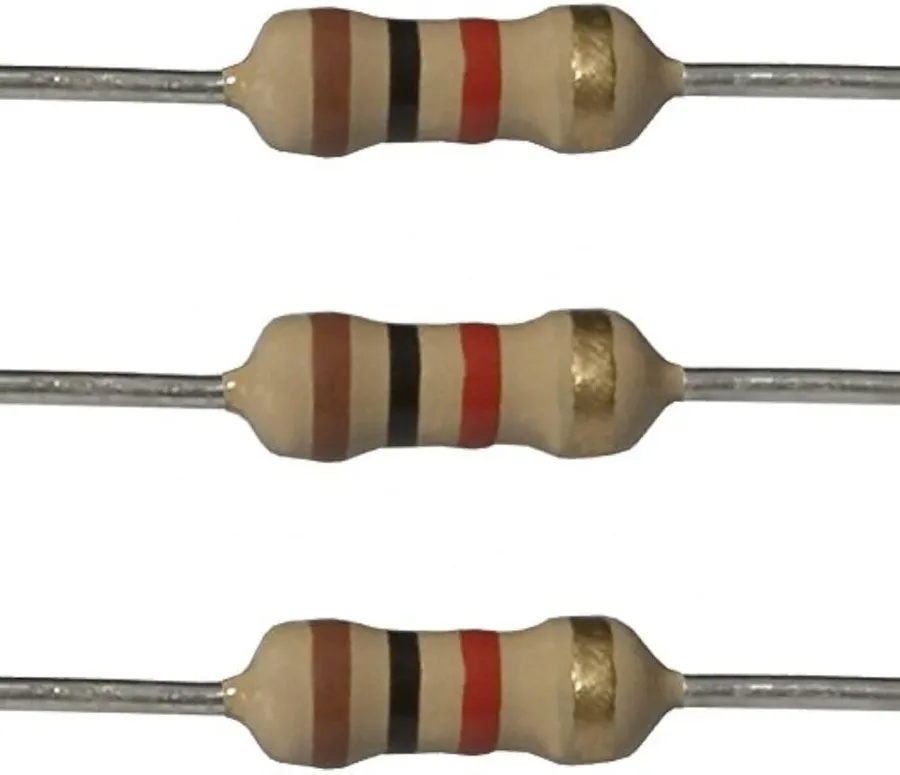
A 1k ohm resistor is a fundamental passive electronic component designed to impede the flow of electrical current, presenting a resistance of 1000 ohms. This standardized value makes it a ubiquitous element in countless electronic circuits, serving to control current and voltage levels within a wide range of applications.
1k Ohm Resistor Color Code Explained


The 1k ohm resistor's value is visually represented using a color code, typically a 4-band system. This standardized system allows for quick identification of resistance and tolerance without the need for measuring equipment. The 4-band system for a 1k ohm resistor is interpreted as brown, black, red, and gold which corresponds to 1, 0, two zeros and a 5% tolerance respectively.
| Band | Color | Digit/Multiplier/Tolerance |
|---|---|---|
| 1st Band | Brown | 1 |
| 2nd Band | Black | 0 |
| 3rd Band | Red | Multiplier: 100 (two zeros) |
| 4th Band | Gold | Tolerance: ±5% |
Practical Applications of the 1k Ohm Resistor

The 1k ohm resistor, a fundamental component in electronics, plays a crucial role in various circuit designs by controlling current flow and voltage levels. Its versatility stems from its standard resistance value which allows for broad applicability in many electronic functions. This section details some practical applications of the 1k ohm resistor.
One of the most common applications of the 1k ohm resistor is in current limiting circuits. When used in series with a Light Emitting Diode (LED), it prevents excessive current from damaging the LED. The resistor effectively limits the current to a safe operating range, ensuring the longevity and reliable performance of the LED. This method protects the LED from burnout due to over current.
Another essential application of the 1k ohm resistor is as part of a voltage divider circuit. By connecting the 1k ohm resistor in series with another resistor, a lower output voltage can be generated from a higher input voltage. This configuration provides the ability to create multiple different voltages from a single source, an essential feature for many circuit designs and is used to provide reference voltages or to step down a voltage signal to a suitable range for an electronic device.
Furthermore, the 1k ohm resistor is employed in biasing transistor circuits. Transistors, essential components in amplifier and switching circuits, require a specific voltage to operate correctly. The 1k ohm resistor helps set the proper bias current and voltage, allowing the transistor to function as intended. Without precise biasing, transistors will not amplify correctly and may be subject to damage.
The use of a 1k ohm resistor is not limited to these three examples. Its utility extends to various other applications, such as in filtering circuits, pull-up or pull-down resistors for digital logic, and as a load in simple circuit tests. Its ease of use, abundance, and standard value make it a favored component in any electronic engineer's toolbox.
1k Ohm Resistor Specifications: Power Rating and Tolerance
The operational characteristics of a 1k ohm resistor are defined by its power rating and tolerance, which are critical for selecting the correct component for a given application. The power rating determines the maximum amount of power the resistor can dissipate before failing, and tolerance defines the acceptable variation in its resistance value.
| Specification | Value | Impact |
|---|---|---|
| Power Rating | 1/4W (0.25W), 1/2W (0.5W), 1W | Determines the maximum power the resistor can safely dissipate; exceeding this rating can lead to resistor damage or failure. |
| Tolerance | 5%, 1% | Indicates the acceptable variation in the resistor's resistance; lower tolerance means greater precision and less variation from the stated 1k ohm value. |
Selecting the appropriate power rating and tolerance is critical to avoid component failure and ensure the proper function of the circuit. A resistor with an insufficient power rating will overheat and can be damaged, which can lead to circuit malfunction. Similarly, a tolerance that is too high can result in a circuit that does not perform as expected. For example, if a circuit requires a very specific current flow, then a lower tolerance resistor is a necessity.
Types of 1k Ohm Resistors

1k Ohm resistors are available in several types, each exhibiting distinct characteristics regarding stability, precision, and cost, influencing their suitability for various applications. The primary types include carbon film, metal film, and wirewound resistors, each with its own set of advantages and disadvantages.
| Resistor Type | Construction | Typical Tolerance | Temperature Coefficient | Noise | Cost | Typical Applications |
|---|---|---|---|---|---|---|
| Carbon Film | Thin carbon film deposited on a ceramic substrate. | 5% - 10% | High | Higher than metal film | Low | General-purpose applications where precision is not critical. |
| Metal Film | Thin metal film (e.g., nickel-chromium) deposited on a ceramic substrate. | 1% - 5% | Lower than carbon film | Lower than carbon film | Medium | Applications requiring better precision and lower temperature coefficient, such as precision circuits. |
| Wirewound | Fine wire wound around an insulating core. | 0.1% - 1% | Very Low | Very Low | High | High-power applications requiring very precise resistance and excellent stability. |
The choice of resistor type hinges on the specific requirements of the application. Carbon film resistors are economical for general use, while metal film resistors offer superior precision and stability. Wirewound resistors, though more expensive, are essential for high-power applications with stringent accuracy requirements. Understanding these differences allows for informed selection.
Frequently Asked Questions About 1k Ohm Resistors
This section addresses common queries regarding 1k ohm resistors, providing clear and concise answers to aid in understanding their use and characteristics. This includes equivalencies, color codes, and practical applications.
-
What is a 1k ohm resistor equivalent to?
A 1k ohm resistor is equivalent to 1000 ohms or 1 x 10³ ohms. It is a standard resistance value commonly used in electronic circuits to limit current, develop voltage drops, or provide bias. The 'k' denotes 'kilo', which means 1000. -
What is the color code for a 1k ohm resistor?
The standard 4-band color code for a 1k ohm resistor is Brown-Black-Red-Gold. The bands represent: 1 (Brown), 0 (Black), two zeros as a multiplier (Red), and 5% tolerance (Gold). Sometimes, a 5-band resistor might be seen with a brown-black-black-brown-gold, this is just a variation with the same value. -
What is the color code for a 1 ohm resistor?
The color code for a 1-ohm resistor is Brown-Black-Black-Gold. The bands represent: 1 (Brown), 0 (Black), no multiplier (Black), and 5% tolerance (Gold). If there is a 5th band it will be brown-black-black-gold-brown, the last brown band indicates a 1% tolerance. -
Is a 100 ohm resistor better than a 1k ohm resistor?
Neither is inherently 'better'; they serve different purposes. A 100 ohm resistor allows more current to pass than a 1k ohm resistor. The choice depends on the specific circuit requirements. Using Ohm's Law (V=IR), if the voltage is constant then an increase in resistance will reduce the current and a decrease in resistance will increase the current. -
How do I calculate current using Ohm's Law?
Ohm's Law states that V = IR, where V is voltage, I is current, and R is resistance. To calculate current (I), rearrange the formula: I = V / R. For example, if you have a 5V supply and a 1k ohm resistor, the current would be I = 5V / 1000 ohms = 0.005A or 5mA. -
How do I select the right 1k ohm resistor for my project?
Consider the power requirements (calculated using P = V^2/R or P=I^2*R), ensure the resistor's power rating exceeds this value to prevent overheating. Then, consider the required tolerance, 5% being standard for most applications and 1% for precision application. Finally, you will consider the package size (through-hole, SMD) based on the physical layout of your project. -
What are common power ratings for 1k ohm resistors?
Common power ratings for 1k ohm resistors include 1/4 watt (0.25W), 1/2 watt (0.5W), and 1 watt (1W). The power rating should be selected to safely handle the anticipated power dissipation in the circuit to prevent failure.
Choosing the Right 1k Ohm Resistor for Your Project

Selecting the appropriate 1k ohm resistor for a project requires careful consideration of several key factors to ensure optimal performance and reliability of the electronic circuit. This involves evaluating the power requirements, desired tolerance, and physical dimensions of the resistor, along with package types like through-hole or surface mount.
| Parameter | Description | Considerations |
|---|---|---|
| Power Rating | The maximum power the resistor can safely dissipate without overheating or failing, commonly available in 1/4W, 1/2W, and 1W ratings. | Must be greater than the expected power dissipation in the circuit. Calculate power dissipation using the formula P = I²R, where I is current and R is resistance. Underrated resistors can fail prematurely or cause damage. |
| Tolerance | The permissible deviation of the actual resistance from the nominal value, often expressed as a percentage (e.g., 1%, 5%). | A lower tolerance indicates higher precision. Choose based on the circuit's sensitivity to resistance variation. General-purpose applications often work well with 5% tolerance. Precision circuits may require 1% or even lower tolerance. |
| Physical Size | The physical dimensions of the resistor, which can be through-hole components with axial leads or surface mount components with various standardized package sizes. | Size is determined by power rating and application. Through-hole components are suitable for breadboarding and prototyping. Surface mount resistors are compact and intended for high-volume manufacturing. |
| Package Type | Refers to the physical method of mounting a component, typically either through-hole or surface mount. | Through-hole resistors are larger with leads that go through holes in a PCB; surface mount resistors are soldered directly onto the surface. Choose based on assembly and space constraints. |
| Temperature Coefficient | Measure of how much the resistance changes per degree Celsius. Low temp coefficients indicate stability across temperature variations. | Circuits operating in variable temperatures require resistors with a low temperature coefficient to maintain consistent resistance values. |
Selecting a resistor of appropriate physical dimensions is critical to ensure proper fit and ease of handling. Through-hole resistors, typically with axial leads, are well-suited for breadboarding and prototyping. Surface mount resistors offer the advantage of smaller size and better performance characteristics at high frequencies. These are typically used in high-volume manufacturing on printed circuit boards (PCBs). The package size (e.g., 0805, 1206 for surface mount) should also match the pads on the PCB for reliable soldering.
Troubleshooting with 1k Ohm Resistors
Effective troubleshooting of 1k ohm resistors involves recognizing common failure modes and employing diagnostic techniques to ensure circuit integrity. This section provides guidance on identifying, diagnosing, and resolving typical issues encountered with 1k ohm resistors, ensuring reliable performance in your electronic projects.
-
Incorrect Color Coding
A common issue is misreading the color bands, leading to the incorrect identification of the resistor value. Verify the sequence and color of each band carefully (brown-black-red-gold for a 1k ohm, 5% tolerance) against a color code chart. Use online tools or apps to double-check the color code if uncertain. -
Open Circuits
An open circuit means the resistor is no longer conducting electricity. This can result from mechanical stress, overheating, or physical damage. Use a multimeter set to resistance mode to check if the resistor reads infinite ohms or an 'OL' (over limit). If so, it is an open circuit and should be replaced. -
Overheating
Resistors can overheat if they are dissipating more power than their rating allows, frequently indicated by a burnt appearance or discoloration. In such cases, the resistor must be replaced with one of a higher power rating, and the design of the circuit should be reassessed to address the root cause of excessive power dissipation. -
Value drift
Resistor values may change over time due to aging, thermal cycling or exposure to other environmental conditions. This can affect circuit performance and reliability. Use a multimeter to measure the actual resistance of the component and compare this value to it's nominal value and tolerance. Replace if it exceeds the designed tolerance. -
Physical Damage
Physical damage to a resistor such as cracks, breaks, or deformation can cause it to not work correctly. Carefully check resistors for physical damage before inserting them in a circuit. Damaged resistors should be replaced before use. -
-
Verifying with a Multimeter
To accurately verify a 1k ohm resistor, use a digital multimeter set to the resistance setting. Ensure the power is disconnected from the circuit before making measurements. Touch the leads of the multimeter to each end of the resistor. The reading should be approximately 1k ohm (1000 ohms), within the tolerance range specified for the resistor.
The 1k ohm resistor, though a small component, is a vital part of countless electronic circuits, as it manages current flow, sets voltage levels, and ensures optimal operation. Understanding the color code, various specifications, and their proper applications, provides a solid foundation for any electronic enthusiast or professional. From powering a simple LED with a 1k ohm resistor to more complex transistor biasing, the 1k ohm resistor remains a versatile component essential for modern electronics. By delving deeper into this component, one can appreciate the role of even the simplest elements in creating the technological landscape we rely upon today.
-
06 Mar 2026 14:08:44 GMT
What is Heavy Copper PCB
-
04 Mar 2026 10:15:22 GMT
How Dose AOI Enhances Solder Paste Inspection For PCB